Execution Governance Infrastructure
Architecture
RIO is not a model. It is a governed execution protocol that sits between an agent and the real world. It does not advise. It gates.
Version 2.0 — Reference implementation: 143 tests, 0 failures
Design principle: fail-closed. If any condition cannot be positively verified, the execution gate remains locked. This is the inverse of most AI systems ("proceed unless blocked").
What RIO Guarantees
No execution without authorization
The execution gate is fail-closed. Without a valid, signed, unexpired, unreplayed token, nothing executes.
Past records cannot be altered
The hash-chained ledger means modifying any entry invalidates all subsequent hashes. Tampering is detectable by any independent party.
Approvals cannot be forged
Ed25519/ECDSA signatures on receipts. Forgery is detectable without access to the signing key.
Tokens cannot be replayed
Single-use nonce registry. Every token is consumed on first use and rejected on any subsequent attempt.
1. The 8-Stage Execution Pipeline
Every action passes through an 8-stage pipeline before execution is permitted. The pipeline is enforced by the Execution/Governance Loop:
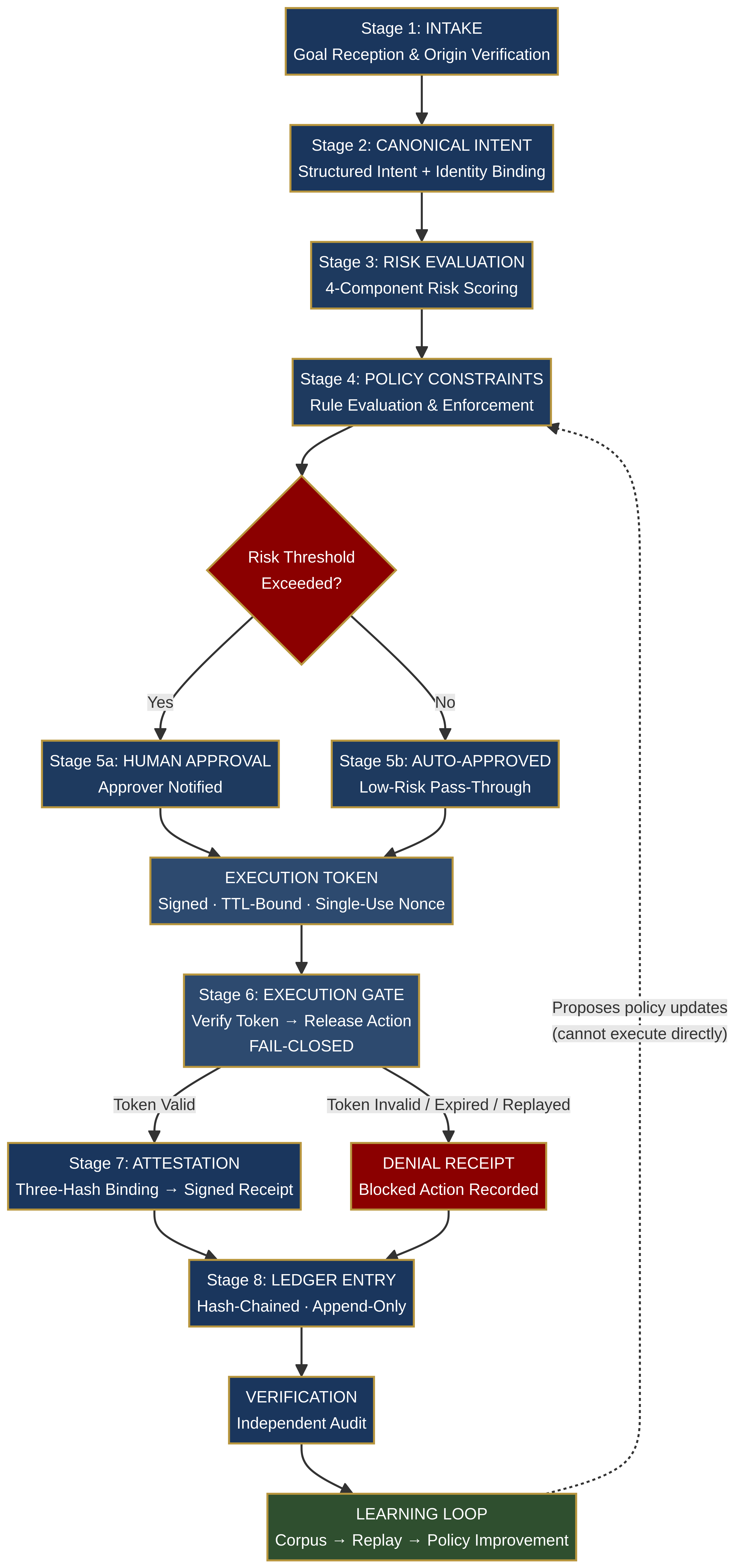
Intake
Raw goal or agent request received
Discovery & Refinement
Vague requests translated into a structured intent (action, target, parameters, requester identity). AI refinement is advisory; a human/system confirms the final intent.
Classification
Action type identified, risk category assigned
Policy & Risk Evaluation
Policy engine checks active rules; 4-component risk score calculated
Authorization
If risk exceeds threshold, human approver is notified. Upon approval, an Execution Token is generated (signed, TTL-bound, single-use nonce)
Execution Gate
Verifies token signature, timestamp, nonce, and kill switch before releasing the action. FAIL-CLOSED.
Post-Execution Verification
Computes three SHA-256 hashes: intent_hash (what was authorized), action_hash (what was executed), verification_hash (what was observed)
Receipt & Ledger
Signed v2 receipt created and recorded in the signed hash-chained ledger
Denials are first-class: Blocked or denied actions generate denial receipts and are recorded in the ledger. The audit trail covers every decision, not just successes.
Three-Loop Architecture
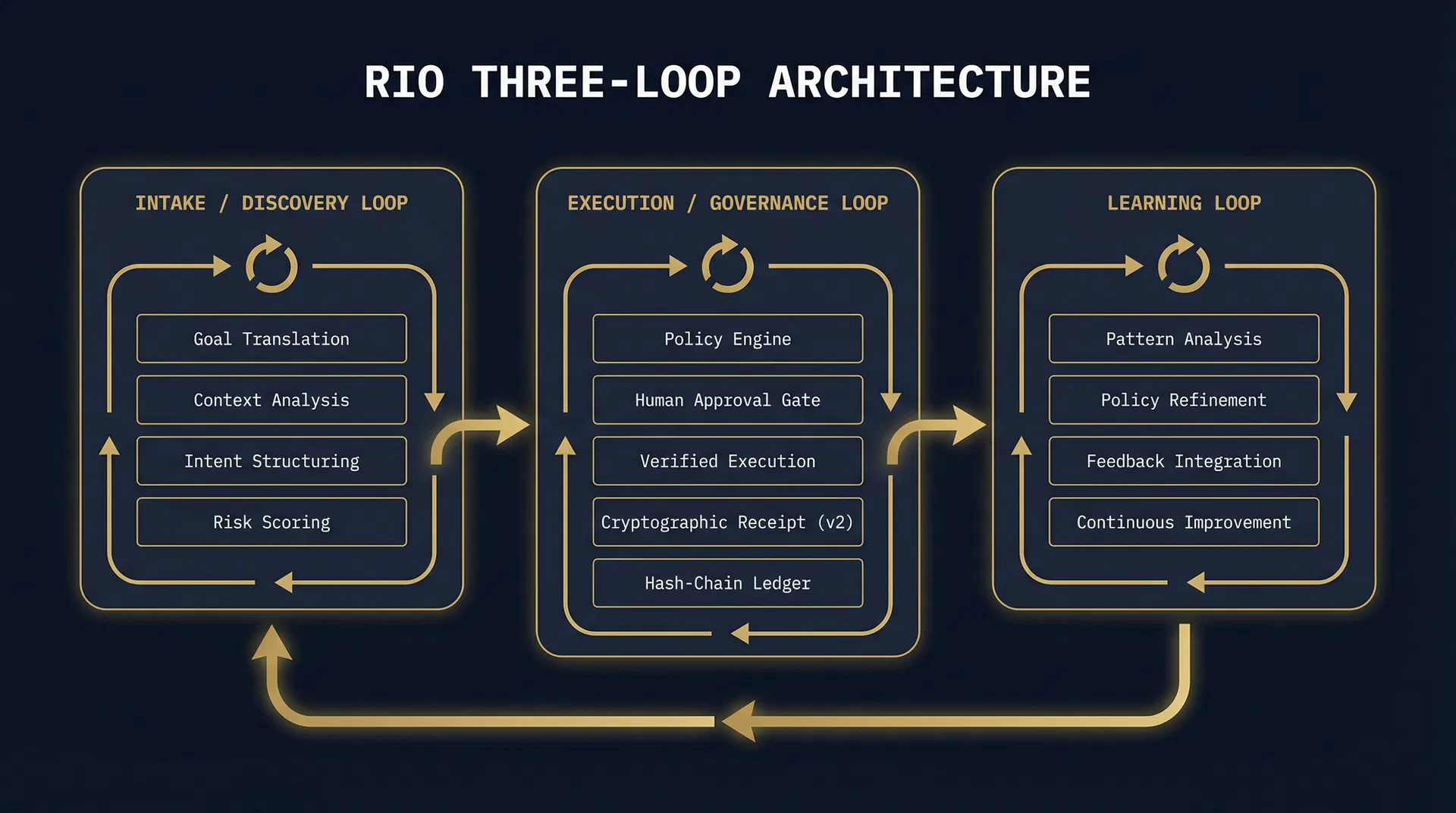
Intake Loop
Goal → structured intent (Universal Grammar Layer)
Governance Loop
Risk → policy → approval → token → gate → verify → receipt → ledger
Learning Loop
Analyzes audit trail, proposes policy updates via replay/simulation. Cannot bypass governance or execute actions directly.
2. Receipts — The Three-Hash Binding
A v2 receipt is a cryptographically signed record of a single decision (approval or denial). The three hashes cryptographically bind what was intended, what was executed, and what actually happened. A mismatch proves drift, tampering, or execution error.
Receipt v2 Contents:
├── intent_hash    (SHA-256)  — what was authorized
├── action_hash    (SHA-256)  — what was executed
├── verification_hash (SHA-256) — what was observed
├── risk_score     (4-component)
├── policy_decision
├── timestamps     (requested, authorized, executed/denied)
├── requester_id + approver_id
├── policy_version + packet_references
└── signature      (Ed25519 / ECDSA)
Receipts are signed with Ed25519/ECDSA. Forgery is detectable without access to the signing key.
3. Ledger — Tamper-Evident History
The v2 ledger is a signed hash chain. Each entry references the previous entry's hash. Any modification to any entry invalidates all subsequent hashes.
Hn = SHA256( En.data + H(n-1) )
Each entry also carries its own signature for independent verification. The ledger is append-only. Current implementation is single-node (distributed ledger is future work).
4. Verification — Independent Audit
RIO provides two standalone verification tools. No trust in the runtime is required:
Receipt Verifier
Validates signature, recomputes hashes, checks TTL/nonce
Ledger Verifier
Recomputes the hash chain and verifies per-entry signatures
How to verify (no access to RIO needed):
Recompute Hn = SHA256(En.data + H(n-1)) — mismatch = tampering
Verify Ed25519 signature against public key
Submit a used nonce → system rejects (replay protection)
Submit expired token → system rejects (TTL default 300s)
Attempt execution without token → gate remains locked
Test harness: 143 automated tests across 12 suites — Core Pipeline, Cryptographic Verification, v2 Receipt System, Denial & Edge Cases, Audit & Traceability, Governance Model, Conformance, Gateway, Independent Verifier, SDK, and Simulator.
5. Threat Model
RIO mitigates execution-layer threats in autonomous AI environments:
| Threat | Mitigation |
|---|---|
| Unauthorized execution | Fail-closed gate — no token = no execution |
| Replay attacks | Nonce registry — single-use tokens |
| Stale authorization | TTL expiry (default 300s) |
| Audit tampering | Hash-chained ledger + per-entry signatures |
| Forgery | Ed25519/ECDSA signatures on receipts |
| Silent denials | Denial receipts — blocked actions are auditable |
Out of scope (by design):
RIO governs what AI systems do, not what they are trained on or what they say.
Full Threat Model6. Trust Model
Who you must trust
The signing key holder
For the authenticity of approvals. Keys are currently software-managed (HSM integration is future work).
The policy author
For the correctness of rules. Policies are versioned and recorded on receipts.
Who you do NOT need to trust
The runtime operator
Receipts and ledger are independently verifiable.
The agent
It cannot execute without a valid token.
The audit system
Hash chain + signatures detect tampering.
7. Regulatory Alignment
RIO provides the infrastructure for a specific, demonstrable requirement: a verifiable, cryptographic record that a specific action was authorized by a specific human, executed under a specific policy, verified against its stated intent, and recorded in a tamper-evident ledger that any independent party can audit.
| Framework | Articles | RIO Mechanism |
|---|---|---|
| EU AI Act | Art. 12, Art. 14, Art. 9 | Receipts/ledger (record-keeping), fail-closed gate (human oversight), risk engine (risk management) |
| NIST AI RMF | GOVERN, MAP, MEASURE, MANAGE | Policy engine, intake loop, risk scoring, approval gate |
| ISO 42001 | A.6.2.8 | Automatic signed receipts (event logging) |
Explore the full specification, schemas, and conformance tests on GitHub.